


By Mike Brown & Jenilee Naidoo
August 2026
For many South African investors, the traditional approach to generating steady income has been straightforward: invest in cash, money market funds or fixed deposits, earn interest, and spend or reinvest the income produced.
However, today’s investment landscape is evolving. Interest rates, whilst remaining relatively high, have fallen steadily in recent times and are likely to decline further. Accordingly, investors are increasingly looking for solutions that can provide regular cash flow without sacrificing long-term capital growth.
This is where income-bearing ETFs are attracting significant attention. In the past two years, 14 Actively Managed ETFs have listed on the JSE, covering both local and global interest rate markets.
What is an Income-Bearing ETF?
An income-bearing ETF is an Exchange Traded Fund that invests primarily in income-generating assets such as bonds, listed property, preference shares, floating-rate notes, credit-linked paper and infrastructural funding instruments.
These ETFs distribute income to investors, typically monthly or quarterly, while maintaining exposure to diversified portfolios of underlying assets. The assets can be issued by Government or public bodies, but also including corporate and private issued debt notes.
During the recent ETFSA webinar, income-focused ETFs were highlighted as a compelling alternative to traditional cash investments, particularly while South African real interest rates provide positive returns.
Graph 1
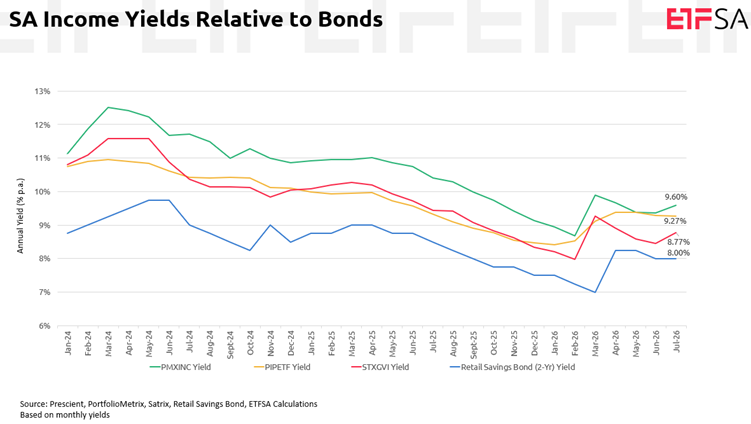
The above graph indicates that the current yield on income ETFs, notably the Prescient Portfoliometrix AMETF (PMXINC) is higher than the yield earned by Fixed Interest Government securities, which can also be purchased in ETF form. The income and bond ETFs also earn yields comfortably higher than those of Government retail bonds.
Why Income ETFs are Becoming More Attractive
Many local income ETFs are currently offering running yields in the region of 8% to 10% per annum as shown in graph 1. In addition, the asset manager of the income fund can also earn a return from trading the portfolio of assets. As interest rates fall, as has been the case locally, the price of fixed interest rate bonds rise. The portfolio manager can also trade the other flexible interest bearing instruments, looking to unlock discounts to maturity, and other price related price changes. Accordingly, over and above the interest rate yields, the income AMETF earns a return on the price movements in the instruments held in the portfolio. As a result, the price of the income ETF will rise, and this adds a positive capital gain to the total return of the income AMETF.
Graph 2
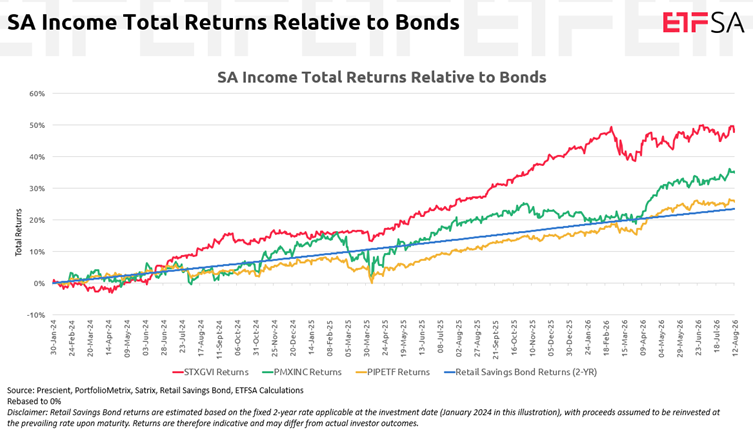
Graph 2 shows the cumulative return over a period of 30 months to mid-August 2026 for a SA Government Bond ETF, the PMXINC AMETF, which invests in 3 year debt instruments, the PIPETF, which invests in one year paper and the cumulative return of a 2-year retail bond. Unlike fixed deposits or retail bonds, income and bond ETFs are readily tradeable on the JSE and offer instance liquidity, or the opportunity to take profits on interest rate movements, if required.
Tax considerations
Income-focused ETFs may derive returns from a combination of interest income, capital gains and, in some cases, dividends. These different sources of return are subject to different tax treatments, with capital gains and dividend income often being taxed more favourably than interest income for individual investors.
Why This Matters
Many investors continue to hold large balances in cash and money market investments because they associate these investments with income generation.
Yet ETFSA’s outlook suggests that cash and money market investments may become a “trap” for investors focused exclusively on current yield. As rates eventually decline, those income streams are likely to reduce, while investors forego the opportunity for longer-term capital growth.
Income ETFs offer a different approach:
- Attractive yields in the current environment.
- Diversified exposure across income-producing assets.
- Potential capital growth over time.
- Some potential tax benefits based on different forms of return
Final Thoughts
Generating income from investments is no longer simply about chasing the highest interest rate available.
For investors seeking sustainable cash flow, particularly retirees and high-net-worth individuals, income-bearing ETFs can provide an attractive combination of yield, diversification and tax efficiency.
When combined with a well-structured withdrawal strategy, investors can enjoy a regular income stream that supports their lifestyle.
In an environment where interest rates are expected to remain elevated for some time but eventually decline, income ETFs may provide one of the most effective ways to balance income needs with long-term wealth preservation and growth.