


By ETFSA, inspired by insights from Dr Ryan O. Murphy, Global Head of Behavioral Insights at Morningstar
When markets turn volatile, as they have again recently, investors often feel the urge to check their account balances more frequently. It’s a natural reaction to uncertainty. But according to Dr Ryan Murphy, this instinct usually hurts more than it helps.
Murphy’s behavioural research highlights a simple truth: the more often we look at our portfolios, the more volatility we believe we see. Every dip feels sharper, every downturn feels personal, and every red number tempts us to act.
Why? Two powerful behavioural forces are at play:
1. Loss aversion: We feel losses about twice as strongly as gains. Short-term views expose us to more perceived losses.
2. Pattern-seeking: Our brains try to find meaning in short-term noise, triggering unnecessary worry and poor decisions.
Murphy’s message is clear: checking too often amplifies emotional reactions and increases the risk of bad decisions.
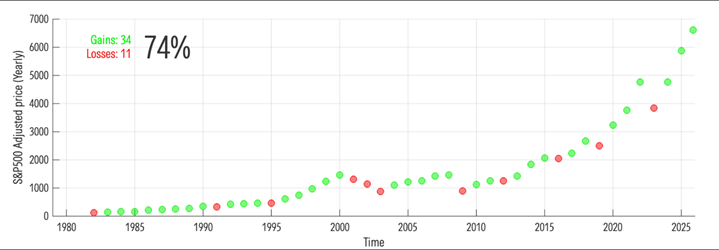
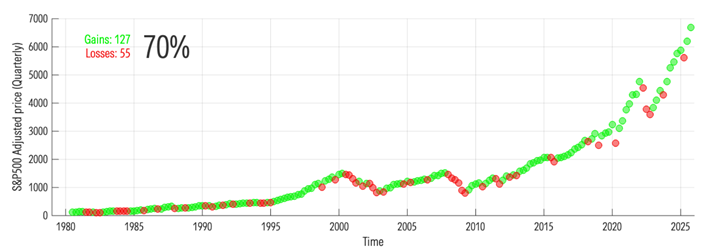
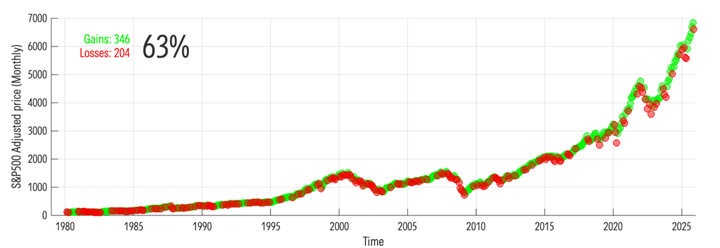
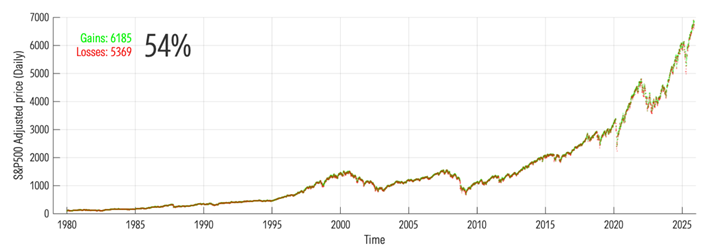
To provide context on Murphey’s broader market behaviour across various time horizons, Figures 1-4 illustrate adjusted price movements across yearly, quarterly, monthly, and daily frequencies. These graphs highlight the distribution of gains and losses over time, and establish a baseline for understanding how return patterns evolve across varying periods. Charts are used for illustrative purposes.
Figure 1: Yearly Adjusted Prices Depicting Gains & Losses
Source: Morningstar (2026)
Figure 2: Quarterly Adjusted Prices Depicting Gains & Losses
Source: Morningstar (2026)
Figure 3: Monthly Adjusted Prices Depicting Gains & Losses
Source: Morningstar (2026)
Figure 4: Daily Adjusted Prices Depicting Gains & Losses
Source: Morningstar (2026)
Zoom Out: Time Is Your Friend
Murphy emphasises that long-term investing success depends on controlling your time horizon. Zooming out from days to years stabilises market movements and reveals long-term growth.
Why This Matters Now
Periods of uncertainty generate more headlines and emotional triggers. Yet market volatility is normal. Good portfolios lose money four to five months a year on average but still grow over time.
As Warren Buffett reminds us: “A tolerance for short-term swings improves our long-term prospects.”
What to Do Instead
– Keep goals front and centre.
– Focus on what you can control.
– Expect turbulence.
– Look less often.
Final Thought
Being an investor is challenging because our brains are not wired for it. But zooming out, focusing on long-term goals, and resisting the urge to check your account too frequently gives you the best chance of staying disciplined.
At ETFSA, we believe long-term investing works – when you allow it the time to work.
Source: Morningstar, Murphy, R.O. (2026), “How Financial Advisors Can Support Clients Through Market Volatility and Uncertainty”.